

TL;DR
We built Capital Anesthesia a custom scheduling platform. It drafts the whole month from the practice’s own rules. The owner just reviews it instead of building it from scratch.
It’s also one place for every request: time off, extra days, coverage, and cancellations. Each dental office logs in to see who’s coming.
What changed
6 hours1 hourto build each month’s schedule
| Task | Before | Now |
|---|---|---|
| Building the month | By hand in Google Calendar, about 6 hours | Drafted from the rules, about 1 hour, mostly fine details |
| Time off and coverage | Texts and calls, remembered at drafting time | Requests in one inbox, approved in one place |
| What offices see | A text with next week’s schedule, every week | Their own login, always current, no patient details |
- Dental offices
- 13
- Anesthesia providers
- 6
- People with accounts
- 20
- Appointments on the calendar
- 798
Counts from the live platform, September 30, 2026.
Google Calendar was never built for this.
Capital Anesthesia is a mobile anesthesia practice. Its providers travel across Washington to different dental offices and give anesthesia on site, so the dentists can focus on the dental work.
Every day, each office needs to know which provider is coming. Every provider needs to know where to drive.
All of it lived in Google Calendar. That meant juggling 13 offices, 6 providers, time off, and standing rules like “this doctor never works Fridays.” Someone had to hold it all in their head and build each month by hand.
Requests made it worse. Providers asked for time off and extra days, and offices asked for coverage or cancelled, all by text or phone call. Every one of them had to be remembered at drafting time. Drafting a single month took about 6 hours.
Then every week, the owner texted each office manager the coming week’s schedule so they knew who was coming.
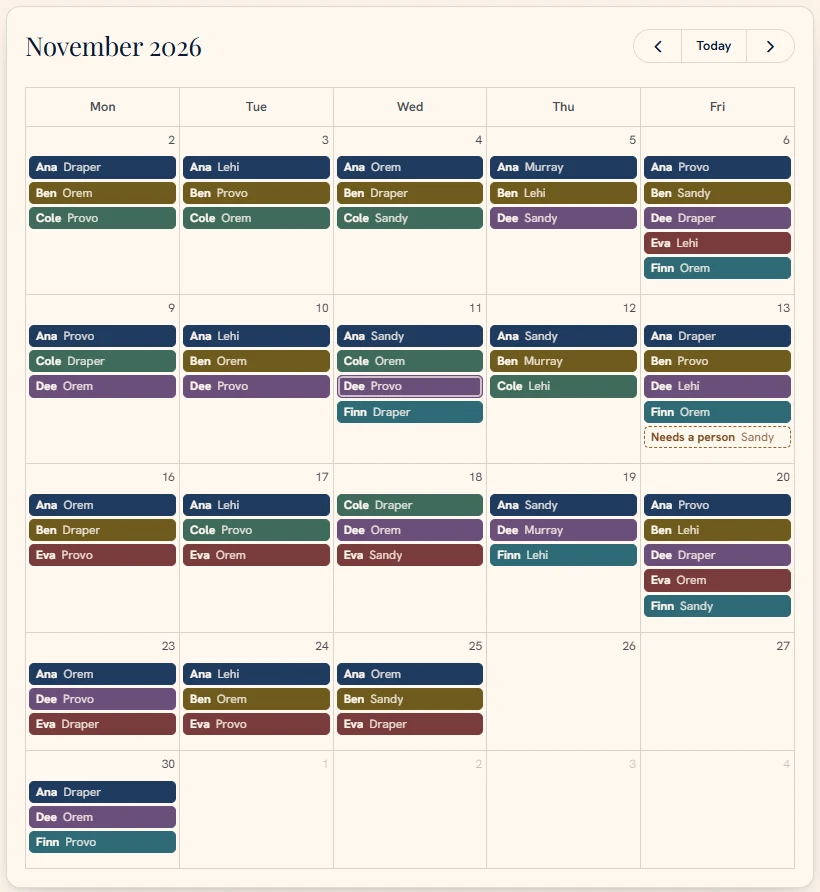
One calendar. Everyone sees their part.
The practice owner
Sees everything: every office, every provider, and every request.
Providers
See their own schedule: where they're going and when.
Dental offices
See who's coming and when. Nothing about patients ever shows up in their view.
Requests run through it too. Providers ask for time off. Offices ask for extra coverage. The owner approves both in one place, and the calendar updates itself.
We built it with the practice, not just for it. Every feature started as something the practice or an office asked for, and we wrote each one up before writing code. That's 27 features since the first line of code on July 15, 2026.
Write the rules once. Get the month drafted.
The practice runs on rules. Some are simple, like one provider per office per day. Some are specific, like which doctor covers an office every third Friday. The owner writes them in plain English.
AI turns each rule into something the scheduler can check. Then the scheduler drafts the whole month. The owner reviews the draft, makes any changes, and publishes it.
When it can't cover a day, it says so. One October draft placed 26 assignments and left one office-day open because a doctor was off. It flagged that day for a person instead of guessing.
The scheduler never guesses. If the rules can't cover a day, a person decides.
What changed.
Building the schedule went from about 6 hours a month to about 1. The offices noticed too.
“Much better now that they can just log on and see it. Office managers prefer it this way.”
In their words
5 out of 5 stars on Google
“We hired Amanecer AI to build a company calendar and an AI-powered scheduler for Capital Anesthesia, our mobile anesthesia company.
The system needed to intelligently plan employee shifts and assign the right offices based on our specific operational needs.
They delivered exactly what we asked for: clean, practical, and built around how our team actually works. The AI scheduler has made coordinating shifts and locations far more efficient, and the calendar is simple for everyone to use.
Communication was clear throughout the project, and they were responsive to the details that matter in a mobile healthcare setting. Highly recommend Amanecer AI if you need thoughtful AI tools that solve real operational problems.
(Would love to show some images of the calendar they built but it all has sensitive information on it.)”
 Eli StakerOwner, Capital Anesthesia · Washington
See on Google (opens in a new tab)
That last line is why the schedule on this page uses made-up names.
Does your schedule live in someone's head?
Tell us how it works today, and we'll show you what it could look like. Start your assessment. It takes a few minutes, and the founders read every answer.
About this page
Counts come from the live platform on September 30, 2026. Reviews are quoted from Google as of October 28, 2026, with one dash changed to a colon. The sample week uses made-up names and runs a small version of the same rule-based scheduling in your browser. No patient information appears anywhere on this page. Built by Rylek Staker and Brizden Staker.